
CFD Fire and Smoke Modelling uses Computational Fluid Dynamics to simulate how fire, heat, and smoke behave in complex building environments.
It helps fire engineers predict smoke movement, assess evacuation safety, and optimize smoke control systems under realistic fire scenarios. This advanced tool supports both prescriptive and performance-based designs, ensuring compliance with UAE Civil Defense codes and international standards like NFPA 92
Performance-Based Design Optimization
It enables engineers to justify alternative fire safety strategies by demonstrating how specific layouts, ventilation systems, or fire barriers perform under dynamic fire conditions—especially useful in non-standard or high-rise buildings.
Accurate Prediction of Smoke Movement
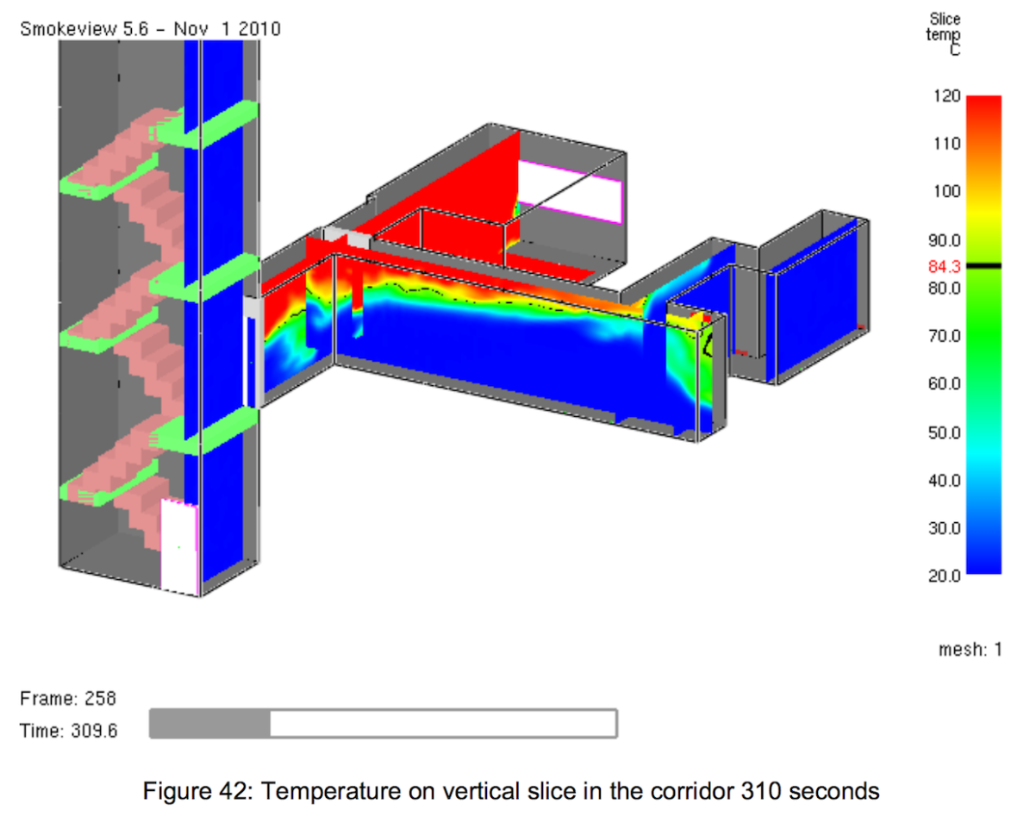
CFD modeling simulates how smoke, heat, and toxic gases travel through complex spaces—helping engineers design effective smoke control systems and safe evacuation routes tailored to real-world fire scenarios.

Enhanced Regulatory Compliance and Safety Assurance
CFD outputs support Civil Defense approvals by providing visual, data-driven evidence of fire safety performance. This builds confidence among stakeholders and helps meet international standards like NFPA 92 and BS 7974.

Fire Engineering Approach
CFD-Based Smoke Control Design: Simulating Fire Behavior, Optimizing Safety, Securing Approval.
The office uses advanced Computational Fluid Dynamics (CFD) tools to simulate how fire, heat, and smoke spread within a building. This includes modeling temperature rise, smoke layer formation, and visibility levels to assess occupant safety and system performance.
Based on simulation results, engineers design or validate smoke management strategies—such as pressurization systems, smoke curtains, and exhaust fans—to ensure effective containment and safe evacuation during fire scenarios.
CFD outputs are used to support performance-based fire safety designs, especially in complex or non-standard buildings. The fire engineering office prepares detailed reports and visual evidence to demonstrate compliance with UAE Civil Defense requirements and international standards like NFPA 92.
Service Benefits
- Why do we need CFD fire and smoke modelling for our project?
-
CFD modelling helps predict how fire, heat, and smoke will behave in your specific building layout. It’s essential for designing safe evacuation routes, verifying smoke control systems, and meeting UAE Civil Defense requirements—especially in complex or non-standard structures.
- Is CFD modelling accepted by Civil Defense authorities?
-
Yes. UAE Civil Defense accepts CFD modelling as part of performance-based fire engineering, provided it’s conducted by a certified House of Expertise using validated software and documented methodology aligned with standards like NFPA 92 or BS 7974.
- How long does a CFD simulation take?
-
Depending on the building size and complexity, a typical CFD simulation can take from a few days to a couple of weeks—including scenario setup, simulation runs, and report preparation. Early planning helps integrate it smoothly into the project timeline.