

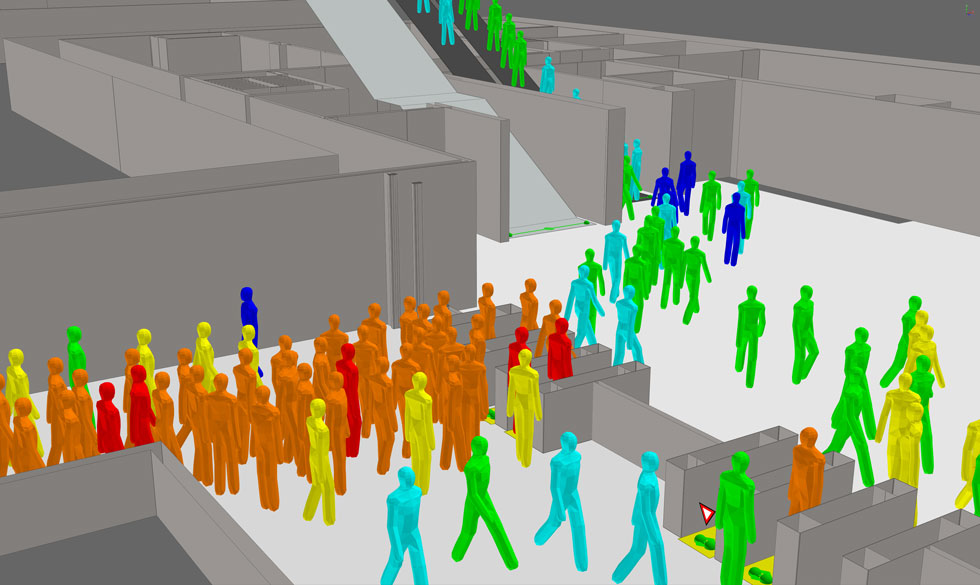
Evacuation Modelling simulates how occupants move through a building during a fire or emergency, helping engineers assess evacuation times, crowd flow, and potential bottlenecks.

It uses software tools to analyze human behavior, exit capacities, and fire growth scenarios to ensure safe and timely egress. This approach supports performance-based fire design and helps meet UAE Civil Defense and international life safety standards.

Optimization of Egress Design

By identifying bottlenecks, congestion points, and inefficient layouts, engineers can redesign pathways, exits, and signage to improve flow and reduce evacuation time. This is especially valuable in high-occupancy or complex buildings like malls, airports, and towers.

Accurate Prediction of Evacuation Times

Evacuation modelling simulates how people move through a building during emergencies, accounting for crowd behavior, exit capacities, and fire growth. This helps determine whether occupants can evacuate within the Required Safe Escape Time (RSET), a critical metric for life safety compliance.

Support for Performance-Based Approvals

Evacuation modelling provides visual and data-driven evidence to justify alternative fire safety strategies. It strengthens submissions to UAE Civil Defense and aligns with international standards such as NFPA 101 and BS 7974, especially for non-prescriptive designs.


Fire Engineering Approach

Evacuation Time Analysis: Simulating Egress, Validating Safety, Securing Compliance.

The office determines the Required Safe Egress Time (RSET) and compares it with the Available Safe Egress Time (ASET) based on fire growth, detection, alarm activation, and occupant response. This ensures that people can evacuate safely before conditions become untenable.

Using tools like Pathfinder or MassMotion, engineers simulate occupant movement during emergencies to identify congestion points, exit delays, and flow inefficiencies. This helps optimize egress routes and improve evacuation strategies for complex or high-occupancy buildings.

The fire engineering office prepares detailed evacuation analysis reports, including visual outputs, assumptions, and safety margins. These are submitted to UAE Civil Defense to demonstrate compliance with life safety codes such as NFPA 101 and local fire regulations

Service Benefits

What is evacuation time, and why is it important?

Evacuation time refers to how long it takes for occupants to safely exit a building during a fire or emergency. It’s critical for ensuring life safety and must be shorter than the time it takes for conditions to become dangerous—known as the Available Safe Egress Time (ASET).

How is evacuation time calculated?

Fire engineers calculate the Required Safe Egress Time (RSET) using factors like alarm delay, occupant response, travel distance, and exit flow rates. This is compared against ASET, which is determined through fire and smoke modelling, to ensure safe evacuation is achievable.

Is evacuation time analysis required for Civil Defense approval?

Yes. UAE Civil Defense requires evacuation time analysis, especially for high-rise, assembly, and complex buildings. It supports performance-based design and helps justify alternative layouts or exit strategies with data-driven safety assurance.